Trending

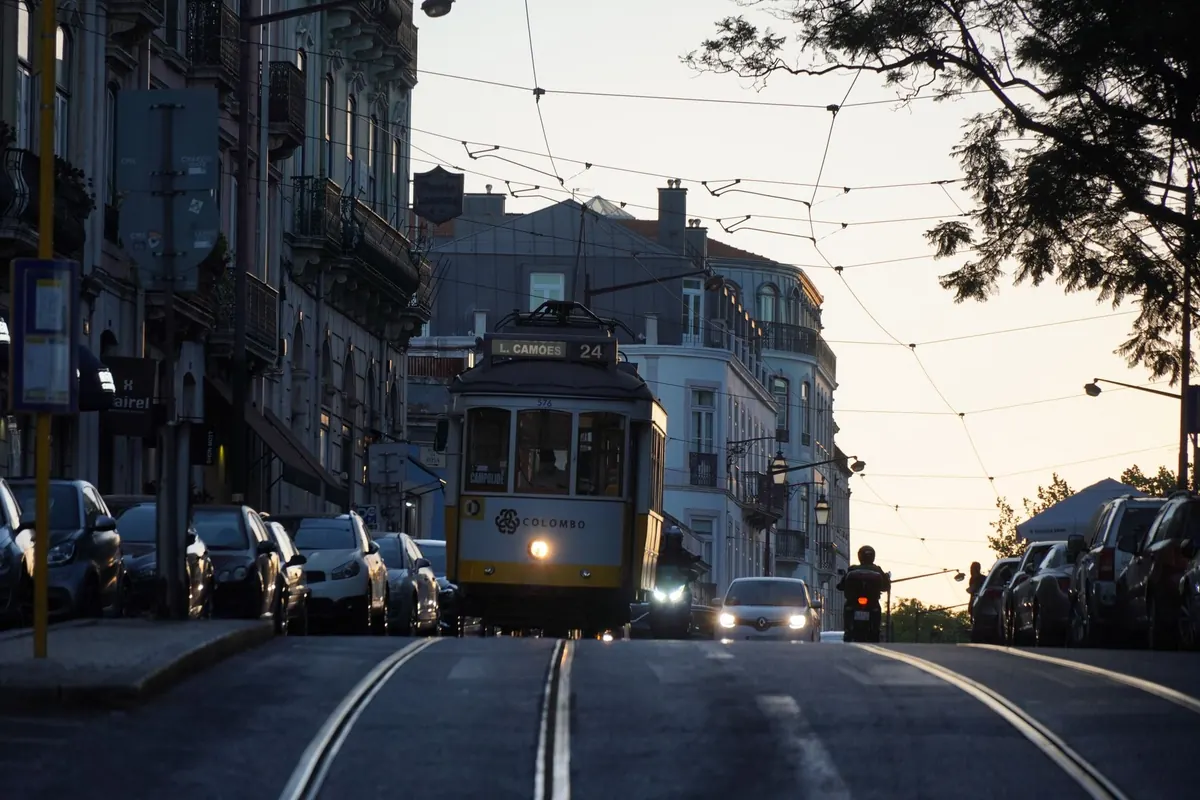
You have seen the photograph: a yellow tram squeezing through a doorway-wide gap in Alfama, laundry hanging above, a passenger leaning out of the window. It is one of the most reproduced images in Lisbon. What the photograph never shows is the queue at Martim Moniz at eleven in the morning, four trams deep, half of it holding a phone in one hand and a suitcase in the other.
Tram 28 is genuinely worth riding. It just rewards a little planning. Ride it at the wrong hour from the wrong stop and you will spend forty minutes standing in a crowded carriage, watching the tile façades slide past through other people's shoulders. Do it the way residents do and it becomes one of the best value hours in the city.
The Eléctrico 28 is a working commuter line, not a sightseeing circuit. It runs between Martim Moniz, at the edge of Mouraria, and Prazeres in Campo de Ourique, roughly 45 minutes to an hour end to end depending on traffic and how many people are squeezing on and off. Along the way it climbs through Graça, drops into Alfama, crosses the Baixa, rattles up through Chiado and Príncipe Real, and finishes past the Basílica da Estrela.
The carriages are historic remodelled trams, and they are charming in the way old public transport usually is: beautiful to look at, unforgiving to sit in. Wooden benches, no air conditioning, windows that open if you are lucky with the latch. There is no commentary and no hop-on-hop-off loop. It is a bus that happens to have a century of atmosphere, and on a busy day it is a bus with a queue.
Timing is the single thing that decides whether this is a delight or a chore. The pattern is fairly consistent through the year, with the obvious exception of summer and cruise-ship days, when it gets worse across the board.
Sundays deserve a note. Early Sunday is calm, but from mid-morning it can be the busiest day of the week, because everyone has the same idea at the same time.
Martim Moniz is the famous starting point, which is precisely the problem. Everyone queues there because it is the beginning of the route, and the queue can swallow an hour of a short trip. If you want the classic experience without the wait, board at the other end.
Start at Prazeres, the western terminus in Campo de Ourique. You will usually find a short line or none at all, and you get the whole route in reverse: first the quiet residential stretch, then Estrela, then the climb into Chiado and the slow descent into Alfama, which builds nicely as a reveal. If you only have time for one direction, this is the more rewarding one.
Another option is to join mid-route. The stops around Rua da Conceição and the Sé put you in the middle of the old town, but you will likely stand. Boarding at Graça works well if you are staying in that direction and want the Alfama stretch without the full loop.
Wherever you get on, do not treat the tram as a place to keep a large suitcase. These carriages are small, the aisles are narrow and the doors are not designed for luggage. Bags go on your lap or under the seat.
The best way to use Tram 28 is as a moving connector rather than a full circuit. Pick two or three stops, get off, walk, and rejoin later or simply continue on foot.
One thing worth doing: ride the Alfama stretch uphill and walk back down through the lanes. The tram cannot stop where you want to linger, and half the pleasure of Alfama is a staircase you did not plan to take.
Skip the full end-to-end loop in peak season. Spending a whole hour standing on a packed tram to see the same city you could see walking is a poor trade. Ride a section, walk two, ride another.
Skip the Baixa segment in the middle of the day if you are there for the scenery. The stretch through the flat grid is functional and slow, and you can cover it on foot faster than the tram will.
Skip the souvenir shops at the tram stops — and the trams themselves if you only care about atmosphere. Tram 12 and Tram 25 both leave from near Praça da Figueira and cover parts of the same old-town terrain with a fraction of the queue. The Elevador da Glória and the Elevador da Bica give you the steep-street sensation without the crowd.
Skip the assumption that nothing can go wrong. Pickpockets do work this line, as they do any crowded tourist route in Europe. Bag in front, phone out of a back pocket, no need for paranoia — just attention.
Get a Viva Viagem card from a metro station machine and load it with zapping credit before your trip. Buying a single ticket on board costs more, and the driver does not always have change. If you plan more than a couple of rides in a day, the 24-hour Carris/Metro pass, which covers trams, buses, funiculars and the metro, usually works out cheaper than buying rides one at a time.
Trams bunch up. The app might show two minutes and deliver fifteen, so give yourself slack rather than building a tight schedule around a timetable. Hold on when you are standing — the tracks are old and the corners are sharp. Offer your seat to anyone who lives there and got on before you did. And if the first tram that arrives is too full to be enjoyable, wait for the next one; in the evening especially, they come more often than they look like they will.
Photo: Stephan Saloth / Pexels